


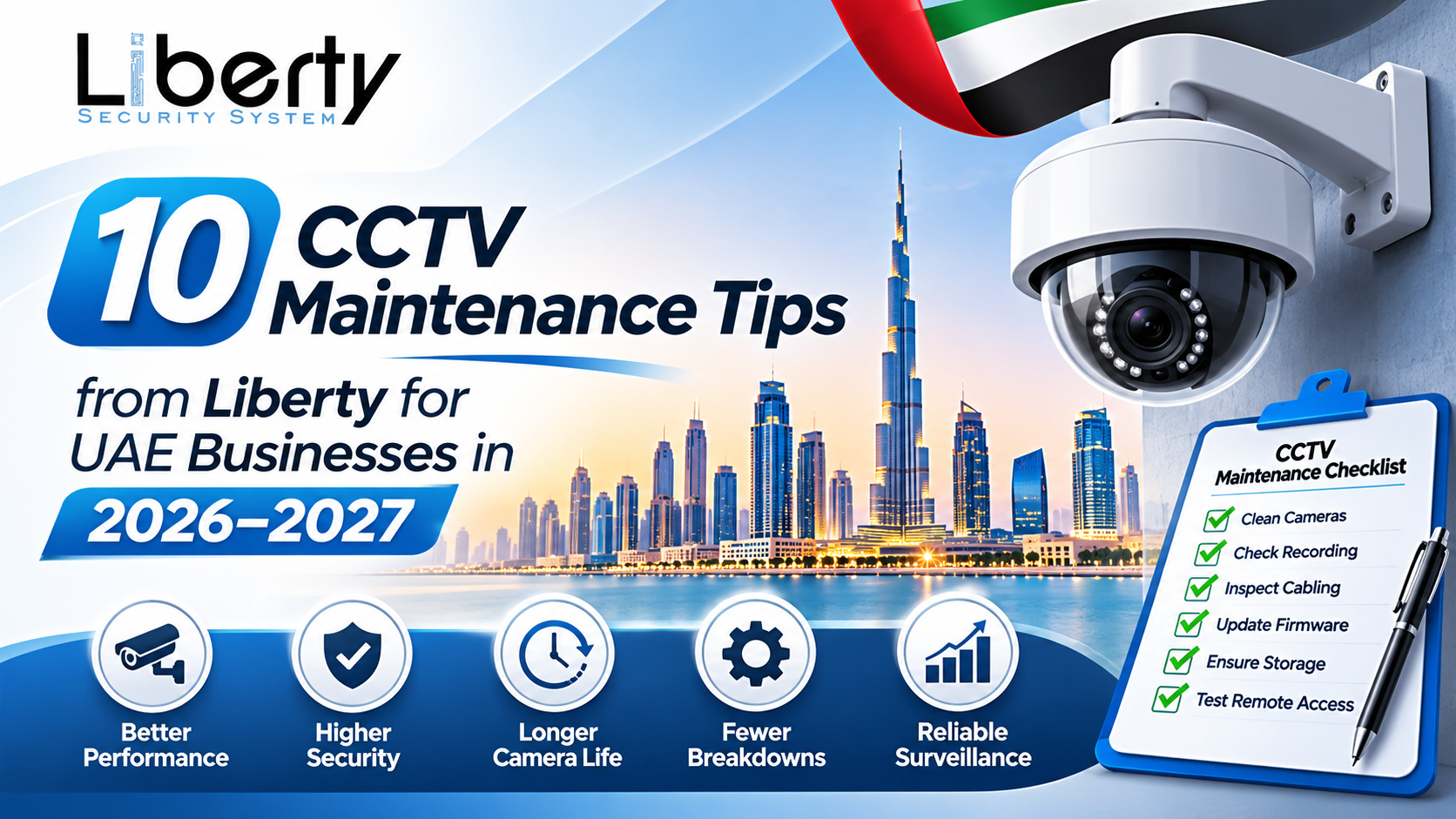

A CCTV system is an important part of business security. Whether it is installed in an office, warehouse, retail store, hotel, or commercial building, it helps monitor activities, protect assets, and provide recorded footage when an incident occurs.
However, installing cameras is only the first step. Without regular maintenance, cameras may develop blurry images, recording interruptions, storage problems, or connectivity issues. These problems can affect the overall effectiveness of a surveillance system.
For businesses investing in CCTV installation in the UAE, regular inspections and preventive maintenance are essential. Liberty Security Systems shares these ten practical CCTV maintenance tips to help businesses maintain reliable surveillance throughout 2026–2027.
10 Essential CCTV Maintenance Tips for UAE Businesses
Dust, fingerprints, sand, and other environmental particles can collect on camera lenses and affect image quality. This is particularly important for outdoor cameras exposed to changing weather and dusty conditions.
1. Clean CCTV Camera Lenses Regularly
Use a soft, lint-free microfiber cloth and suitable cleaning materials to remove dirt without scratching the lens. Avoid spraying cleaning solutions directly onto the camera.
Liberty tip: Include camera lens cleaning in your regular maintenance schedule to help maintain clear footage.
2. Inspect Camera Positioning and Coverage
Cameras can become misaligned due to accidental movement, vibrations, or changes in the surrounding environment. A camera that once covered an entrance may no longer capture the required area properly.
Inspect camera angles and check whether important locations such as entrances, exits, reception areas, corridors, and parking spaces remain visible.
For businesses considering CCTV installation in Dubai, professional site planning can help reduce blind spots and improve surveillance coverage from the beginning.
3. Check Recording Quality and Playback
A CCTV camera may appear to be working while the recording system is experiencing problems. This is why checking live footage alone is not enough.
Regularly review recorded footage to confirm that:
- Cameras are recording continuously as configured.
- Video quality is clear enough for the intended purpose.
- Date and time stamps are accurate.
- All connected cameras appear in the recording system.
- Playback works without unexpected interruptions.
Testing playback helps identify recording issues before footage is needed for an investigation.
4. Monitor DVR and NVR Storage Capacity
Digital Video Recorders (DVRs) and Network Video Recorders (NVRs) store CCTV footage. If storage capacity is insufficient or a hard drive develops a fault, recordings may become unavailable or retention periods may be shorter than expected.
Check storage health, available capacity, recording schedules, and retention settings regularly. Businesses should also confirm that their storage arrangements meet applicable regulatory and operational requirements.
5. Inspect Cables, Connectors, and Power Supply
Loose connections, damaged cables, and unstable power supplies can cause cameras to disconnect or stop recording.
During maintenance, inspect visible cables, connectors, network ports, power adapters, and equipment cabinets. Outdoor cabling should also be checked for physical damage and exposure to environmental conditions.
Any damaged electrical or network components should be assessed and repaired by qualified technicians.
6. Test Night Vision and Low-Light Performance
Outdoor and indoor cameras may need to capture footage in low-light conditions. If infrared LEDs or low-light settings are not working correctly, recordings may become too dark or unclear.
Test cameras at different times of the day and check whether night-time footage provides sufficient visibility. Also inspect nearby lighting sources that may create glare or shadows.
This is particularly important for warehouses, parking areas, building entrances, and outdoor commercial spaces.
7. Check Wi-Fi Camera Connectivity
Wireless surveillance systems depend on stable network connectivity. Weak Wi-Fi signals, router problems, interference, and network changes can interrupt video transmission.
Businesses using wireless surveillance should regularly check signal strength, camera connection status, router performance, and network security settings.
Professional WiFi camera installation should also consider camera placement, distance from access points, bandwidth requirements, and the number of connected devices.
8. Update Firmware and Secure Camera Access
CCTV systems use software and firmware to manage camera functions, recording, and remote access. Outdated firmware may leave devices exposed to known security vulnerabilities or compatibility problems.
Businesses should:
- Check for manufacturer firmware updates.
- Change default passwords.
- Use strong, unique login credentials.
- Restrict access to authorised users.
- Enable secure remote access where supported.
- Remove access for employees who no longer require it.
Updates should be planned carefully and tested to avoid disrupting active surveillance.
9. Test Remote Monitoring and Alerts
Many modern CCTV systems allow authorised users to view footage remotely through compatible applications or monitoring platforms.
Test remote viewing periodically to confirm that cameras remain accessible and notifications work as configured. Check whether authorised users can access live feeds, playback recordings, and receive relevant system alerts.
Businesses should also review user permissions regularly to ensure that footage is accessible only to people with appropriate authorisation.
10. Schedule Professional CCTV Maintenance
Routine visual checks are useful, but they do not replace professional maintenance. A qualified technician can inspect camera performance, recording equipment, network connections, storage, software settings, and system configuration.
Businesses should maintain a service record containing inspection dates, identified issues, repairs, firmware updates, and equipment replacements.
For applicable Dubai installations, businesses should also confirm that their CCTV maintenance arrangements meet relevant Security Industry Regulatory Agency (SIRA) requirements. Liberty highlights regular maintenance and timely upgrades as part of its CCTV support approach.
Why CCTV Maintenance Matters for UAE Businesses
The UAE’s commercial environments include offices, warehouses, retail properties, hospitality facilities, and industrial locations. Each setting has different surveillance requirements.
Regular maintenance can help businesses:
- Reduce unexpected camera and recording failures.
- Maintain useful image and recording quality.
- Identify storage and connectivity problems early.
- Improve system security and access control.
- Extend the useful life of surveillance equipment.
- Maintain readiness for applicable compliance inspections.
Businesses should consider maintenance requirements while planning their initial installation instead of waiting until a camera or recorder stops working.
Why Choose Liberty Security Systems for CCTV Installation and Maintenance?
Liberty Security Systems provides CCTV camera installation solutions for businesses and properties in Dubai, Sharjah, and across the UAE. Its services include site assessment, camera selection, installation, system configuration, and ongoing support.
As a SIRA-approved CCTV provider in Dubai, Liberty focuses on suitable equipment selection, professional installation, system testing, and maintenance support. Its CCTV solutions include recognised brands such as Hikvision, Dahua, Bosch, CP Plus, Samsung, Ezviz, and Tiandy.
Whether your business needs a new surveillance setup, a wireless camera configuration, or maintenance for an existing installation, Liberty can help assess the requirements and recommend a suitable solution.
Conclusion
A reliable CCTV system needs regular attention to perform effectively. From cleaning camera lenses and checking recording quality to monitoring Wi-Fi connectivity and securing user access, these ten maintenance practices can help UAE businesses maintain better surveillance throughout 2026–2027.
If your organisation is planning CCTV installation in the UAE or needs professional maintenance for an existing system, contact Liberty Security Systems to discuss your requirements.

