


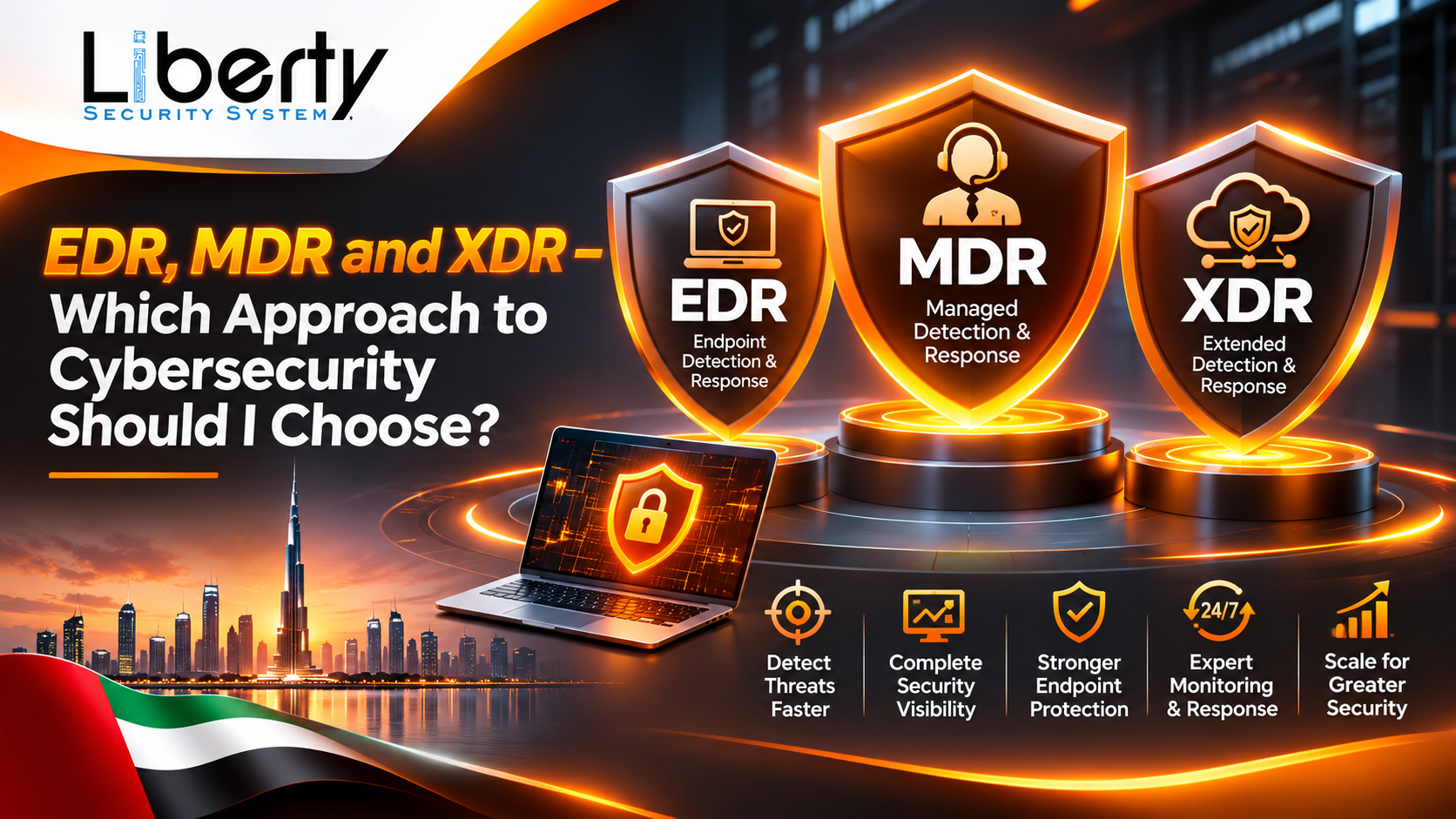

With increasingly complex cybersecurity threats, endpoint protection and threat detection have become crucial to businesses in the UAE. Businesses use a wide range of IT devices including laptops, desktops, servers, cloud applications and networks to manage their day-to-day operations. Unfortunately, any connected device or system can be vulnerable to attacks.
Traditional anti-virus solutions may not provide businesses with the visibility required to tackle modern security threats. As a result, many organisations are turning to cutting-edge security solutions such as Endpoint Detection and Response (EDR), Managed Detection and Response (MDR) and Extended Detection and Response (XDR).
Whilst all offer enhanced cybersecurity, they differ in terms of monitoring, threat detection and management.
Understanding how EDR works and the difference between them can help you choose the right solution for your organisation in the UAE.
1. What is Endpoint Detection and Response (EDR) is a cybersecurity solution that includes monitoring, threat detection and response
An endpoint could be a laptop, desktop or server used within your organisation. These devices often interact with a variety of applications, emails or websites and therefore can be vulnerable to malwares, ransomware and unauthorised access.
EDR technology constantly gathers and analyses endpoint activity to help detect any potentially malicious activity.
Key features of EDR include:
- Monitoring of endpoints.
- Identify any suspicious processes.
- Detects any malware or ransomware activity.
- Investigates security incidents.
- Isolates any compromised devices.
- Threat detection and response.
- Provides visibility of endpoint activity.
An example of this would be if an employee accidentally downloaded a malicious file. EDR will detect any suspicious activity.
Who should use EDR?
If you want to increase visibility of endpoints and have an in-house IT/security team then EDR is a good option.
If you are looking for EDR solutions in Dubai then it may be suitable for you.
2. What is Managed Detection and Response (MDR)) is a cybersecurity solution offering that uses advanced security with expert monitoring and response.
Rather than using traditional security software, MDR includes an external cybersecurity team working to detect threats, investigate any alerts and help to deal with any potential threats.
MDR often work with EDR/XDR platforms to detect any suspicious activity.
Key features of MDR include:
- 24/7 monitoring.
- Threat detection and investigation.
- Analysing and prioritising alerts.
- Proactive threat hunting.
- Containment and incident response.
- Security reporting and recommendations.
- Help dealing with threats.
An example of this would be if one of your employees devices became infected with ransomware out of hours. The MDR team will investigate the alert and implement containment.
Who should use MDR?
MDR would be a great option for SME’s that don’t have their own dedicated cybersecurity team.
You will gain the advantage of expert security whilst not having to employ a full security operation centre (SOC).
3. What is Extended Detection and Response (XDR)?
Extended Detection and Response (XDR) includes multi-source security information that can help organisations detect threats.
Whilst EDR focuses on endpoint devices, XDR can join up various elements of security including endpoints, networks, email, cloud and identity.
This provides greater visibility for your security teams to understand how attacks are happening.
Key features of XDR include:
- Centralised security monitoring.
- Correlate threats.
- Network and endpoint visibility.
- Email and cloud security.
- Advanced threat investigation.
- Incident response.
- Security analysis and reporting.
An example of this could be if there was a cyberattack due to phishing. This would infect an employee and cause issues with a connected business application. XDR can correlate alerts to help detect wider patterns of the attack.
Who should use XDR?
XDR is suitable if you have a complex IT environment. If you have a variety of security technologies, cloud infrastructure and want greater threat visibility then it can be a great option.
It can be very useful for large enterprises with multiple offices, employees working remotely and a hybrid IT environment.
XDR is a mainly a platform. It can be managed by your own security team or with a managed service.
4. EDR, MDR and XDR – Key Differences
Each of these options aim to improve your cybersecurity. However, each will have a different main function.
- Security Solution Focus Best For
- EDR Endpoints with monitoring In-house IT security team
- MDR Expert monitoring, investigation and response Outsourced security
- XDR Correlate security information Complex IT environment
The most important difference between EDR/XDR and MDR is that MDR is a managed service. Whilst EDR/XDR are security technologies. MDR companies may use EDR/XDR technologies or a variety of security solutions depending on your requirements.
5. Which Solution Should I Choose for My Business in the UAE?
Ultimately, what you choose will depend on the size of your company, your infrastructure, your cybersecurity risks and resources.
Consider the following:
Choose EDR If You Want Enhanced Endpoint Protection
If you mainly require endpoint threat detection, have in-house IT/cybersecurity team, want visibility of any suspicious activity on devices, can investigate and respond to alerts and want centralised endpoint monitoring then EDR could be the right choice. For example, a small professional services company with their own IT admin may use EDR to monitor their employees laptops, desktops and business servers.
Choose MDR If You Require 24/7 Monitoring
If you don’t have a dedicated security team, require constant monitoring, have employees working different shifts/locations, want expert investigation and response and want to outsource your security then MDR may be more suitable. For example, a growing business in Dubai who have long hours may benefit from MDR.
Choose XDR If You Want Greater Visibility
If you have multiple security platforms, cloud and on-premise infrastructure, want greater visibility of your endpoints, networks and emails, your security team deal with complex investigations and want to correlate security alerts then XDR may be a good option. For example, a large enterprise with multiple offices, cloud applications and remote employees may benefit from XDR as it can detect threats across their connected infrastructure.
6. Key Things to Consider Before Investing in EDR, MDR or XDR
Before you decide on a cybersecurity solution, you should consider your current security and what you require.
Consider the following:
- Size of your business – How many endpoints, servers, users, applications and offices do you have?
- Do you have the technical knowledge within your IT team to investigate and respond to alerts?
- Do you need constant monitoring throughout the day?
- How do your employees access business applications? Do they use office, home or cloud networks?
- Will the solution integrate with your current firewalls, endpoint protection, emails and security?
- How will you investigate, contain, escalate and resolve threats?
- Cost – How much will you be paying for licencing, implementation, monitoring, maintenance and managed service?
By carrying out a cybersecurity assessment you can identify any gaps and ensure you are choosing a solution that provides the right protection without any unnecessary complexity.
7. Why Choose Professional EDR and Endpoint Security?
Whilst implementing security software is important, it is also important that it is set up correctly, constantly monitored, updated and you have a process in place to investigate threats.
Working with an experienced cybersecurity provider can help you set up and manage your endpoint security.
If you are looking for EDR solutions in Dubai then we can help you with:
- Assess your endpoint security.
- Setup EDR.
- Centralised endpoint management.
- Implement security policies.
- Monitor and investigate threats.
- Help with incident response.
- Optimise your security.
A well managed endpoint security will help improve visibility of threats, faster response times and an overall improved security.
8. Why Choose Liberty Security Systems for your Endpoint Security in the UAE?
Choosing the right partner for your cybersecurity is key to ensuring you have the correct endpoint security in place.
We offer endpoint protection solutions, EDR, MDR and XDR solutions to businesses in Dubai and throughout the UAE. We focus on helping organisations improve their endpoint security, threat visibility and manage any new threats.
Our endpoint security solutions include:
- EDR
- MDR
- XDR
- 24/7 monitoring and response.
- Centralised endpoint management.
- Cloud and on-premise.
Solutions using platforms such as CrowdStrike, SentinelOne, Microsoft Defender for Endpoint and Sophos.
You can look at solutions based on your current infrastructure, capabilities and requirements.
Conclusion
EDR, MDR and XDR all play different roles in your cybersecurity. EDR provides visibility and response, MDR provides expert monitoring and response and XDR joins up security.
Depending on your infrastructure, security capabilities, monitoring requirements and goals, you may find one solution more suitable.
If you have an in-house IT team, EDR may be suitable. If you want greater visibility, then XDR may be a good option. If you don’t have dedicated security resources then MDR may be worth looking into.
Are you looking for reliable EDR solutions in the UAE? Get in touch with Liberty Security Systems to discuss your endpoint security requirements. We can help you choose the right EDR, MDR or XDR solution for your business.

