


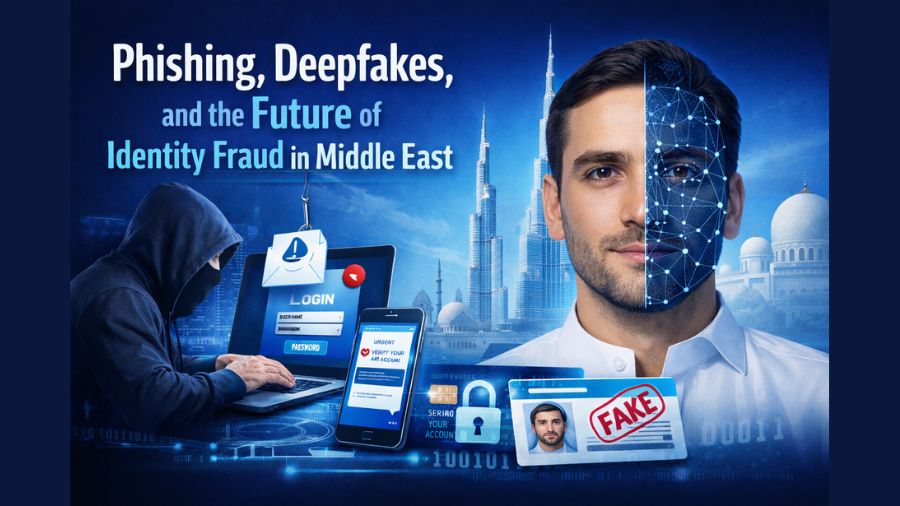

The Middle East, with its quick digital transformation, burgeoning financial hubs such as Dubai, and a big, tech-savvy expatriate population, has become a main target for sophisticated cybercriminals. The conventional dangers of easy scams are quickly being replaced by extremely modern methods such as Phishing and Deepfake scams, basically changing the landscape of identity fraud in Middle East.
Check out the enhanced danger of digital identity fraud in the region and highlight the vital cybersecurity solutions that companies and people should adopt to secure themselves. For companies looking for trusted IT support and protection, collaborating with a professional provider such as Liberty UAE is no longer optional; it is vital.
Table of Contents
The Rising Tide of Identity Fraud in Middle East
Current reports indicate a remarkable upward trend in identity fraud in Middle East, with some nations watching the highest evolution rates internationally. This surge is fueled by two main factors – the region’s economic evolution, which presents big financial targets, and the enhanced sophistication of the attacks themselves.
1. Phishing and Social Engineering Attacks – A Timeless Threat, Reborn
Phishing, the method of tricking people into revealing sensitive details, has always been a primary threat. However, it has grown into a far riskier weapon through social engineering attacks.
- Spear-Phishing – Rather than generic emails, attackers make extremely personalized messages, usually impersonating a reliable colleague, CEO, or government official. These emails are made to look official, referencing real projects or events, making them almost impossible for the human eye to detect.
- Whaling and BEC – These attacks target high-level executives or financial controllers, utilizing a spoofed email address to trick them into authorizing big wire transfers to fraudulent accounts. This is a typical and highly expensive form of Middle East Identity Fraud.
- Vishing and Smishing – Voice and SMS phishing attacks exploit the trust people place in their phones. Scammers utilize fake caller IDs to impersonate banks or service providers, urging the victim to share OTPs or personal details.
The efficiency of these attacks depends on trust and urgency. Cybercriminals exploit human psychology to sidestep technical protections.
2. The Deepfake Revolution – The Ultimate Impersonation
The biggest game-changer in digital identity fraud is the rise of Deepfakes. Thanks to an accessible Generative AI tool, fraudsters can now make ultra-realistic fake videos, audio, and even forged identity documents in minutes.
A. Deepfake Identity Scams – These attacks are particularly developed to sidestep advanced protection standards, specifically those utilizing biometric verification during client onboarding or high-value transactions.
- Video Impersonation – A fraudster utilizes a deepfake video overlay to impersonate a legal person during a video call-based KYC procedure, fooling the system into considering the fake identity is real.
- Voice Cloning – This is utilized in ‘vishing’ scams where the voice of a senior manager or family member is cloned with frightening precision. A cloned voice message to a finance department demanding an emergency fund transfer is a strong instance of phishing and deepfake identity fraud merged.
B. The Sophistication Shift – Attackers are moving away from high-volume, low-quality attacks to fewer, more sophisticated, and much more harmful, complicated fraud attempts. The Middle East has witnessed deepfake-driven fraud, making it a crucial regional consideration.
Fortifying Defenses – IT Solutions for Business Users in Dubai and UAE

The financial industry, professional services, and online media in the United Arab Emirates are the most targeted sectors. Companies should acknowledge that their conventional protection controls are usually insufficient against the new, AI-driven threat landscape. This requires a forceful strategy powered by modern IT solutions in UAE.
1. Advanced Anti-Spoofing and Impersonation Solutions
To combat the blend of phishing and deepfakes, companies require specialized protections that go beyond common email filters.
Anti spoofing and impersonation solutions in Dubai are now a basic protection pillar.
- Email Authentication – Executing strong protocols such as SPF and DMARC is non-negotiable. These verify the sender’s recognition and control domain spoofing.
- AI-Powered Threat Detection – The next generation of protection uses Artificial Intelligence and machine learning to research email traffic for subtle anomalies that a human might miss. This comprises checking the header, content, sender behavior, and even the writing style to flag impersonation attempts.
- Liveness Detection Technology – For companies that utilize biometric authentication, new Anti spoofing and impersonation solutions employ liveness detection. This technology utilizes modern analysis to make sure the person being examined is a true, live human and not a static image or a deepfake video overlay.
2. Behavioral Biometrics and Risk-Based Access
Identity verification is moving from a single point-in-time check to constant supervision.
- Continuous Monitoring – Systems track remarkable user habits, like keystroke dynamics, mouse movement patterns, and navigation ways. If an account is accessed by an attacker, the change in behavior can trigger an instant notification or step-up authentication.
- Multi-Factor Authentication – While not foolproof, demanding MFA for all systems, particularly management and financial accounts, remains a common but vital layer of protection.
3. Employee Awareness and Training
The human component remains the weakest link in the protection chain. No amount of technology can prevent a well-executed social engineering attack if an employee isn’t vigilant.
- Regular Phishing Simulations – Corporations in the United Arab Emirates are performing realistic phishing, vishing, and smishing tests to train staff to spot suspicious communications.
- Deepfake Awareness – Training should now comprise particular instances of how deepfake video and audio can be utilized to manipulate them, stressing the significance of verifying out of band prior to working on urgent approaches.
The Role of IT Support in UAE

For companies in the United Arab Emirates, handling these complicated cyber security solutions in UAE demands professional assistance. Providers that deliver broad IT services in UAE are crucial partners in this fight.
A respected IT support corporation, like Liberty UAE, delivers vital services that address both the technological and human vulnerabilities –
1. Managed Security Services – 24/7 supervision and management of protection infrastructure to make sure real-time threat detection and quick incident response.
2. Bespoke Compliance Solutions – Making sure that a company’s protections comply with stringent local rules, such as the UAE Cybercrime Law and data protection rules.
3. Security Architecture Design – Integrating modern Anti spoofing and impersonation solutions in UAE smoothly into current networks without disrupting regular functions.
By taking advantage of professional IT support in Dubai, companies can pay attention to their core purposes, understanding that their digital recognition and financial assets are secured by a modern protection structure developed to combat the future of fraud.
Conclusion
In the Middle East, the combination of sophisticated phishing and deepfake identity fraud poses an unprecedented threat to digital trust. Relying solely on human judgment is a recipe for disaster due to the ease with which criminals can create convincing narratives, spoof identities, and clone voices.
Businesses in the Middle East need to shift from a reactive to a proactive security approach in order to protect themselves from the growing threat of identity fraud. This entails implementing state-of-the-art techniques like continuous behavioral biometrics, stringent email authentication, and AI-driven liveness detection.
Organizations can create an adaptable defense system that can fend off the constantly changing Social Engineering Attacks by putting in place comprehensive IT solutions for business users in Dubai and collaborating with reliable specialists like Liberty UAE. This will guarantee that their people, data, and finances stay safe in this ever-changing digital environment.
Also Read: Central Bank of UAE Cybersecurity Regulations – Guide for Financial Institutions