


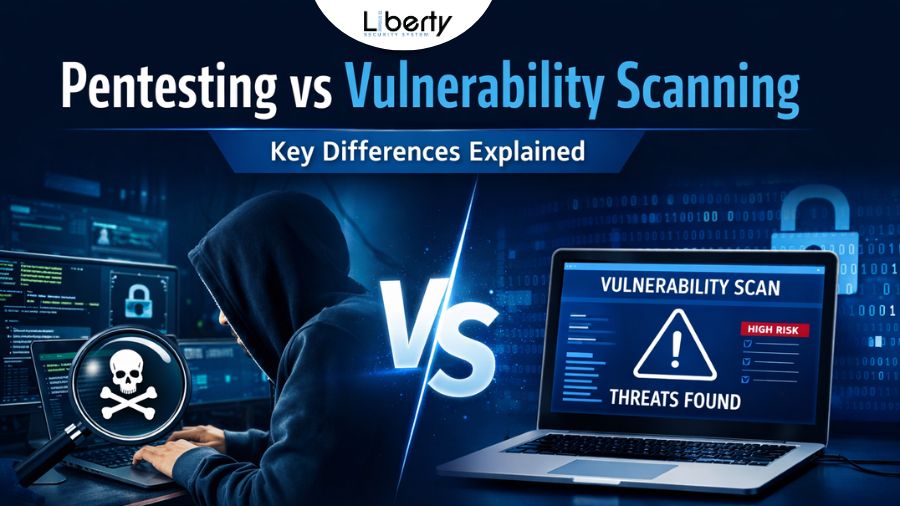

Protecting your company’s IT infrastructure is crucial in the modern digital world, where cyber threats are always changing, particularly in a vibrant city like Dubai. Any strong security strategy is built upon two fundamental techniques: pentesting and vulnerability scanning. Despite their frequent confusion, they have different functions and are essential parts of a thorough security strategy called Vulnerability Assessment and Penetration Testing (VAPT).
Any organization, from a small company in need of dependable IT support in Dubai to a large corporation looking for cutting-edge cybersecurity solutions in the UAE, must comprehend the main distinctions between pentesting testing and vulnerability scanning. Working with a knowledgeable supplier like Liberty UAE guarantees that you successfully apply both strategies.
Table of Contents
What is Vulnerability Scanning? (The Broad Check-Up)

Vulnerability Scanning is the automated, comprehensive, and consistent process that methodically discovers and reports existing security vulnerabilities in networks, applications, and systems.
Vulnerability Scanning
You might as well consider it a quick, regular health check-up for your whole IT environment.
The Process – Automated and Wide –
1. Identification – Automated tools scan all your systems using a huge database of known vulnerabilities (most of them linked with Common Vulnerabilities and Exposures or CVE numbers). The scanning listens to check for –
- Missing security patches and software updates.
- Weak configurations (like default passwords).
- Common flaws in network devices, operating systems, and applications.
2. Reporting – The scanner creates a report that contains every detected vulnerability, usually organized according to severity (for example, the Common Vulnerability Scoring System or CVSS may be applied).
3. Remediation Guidance – The tool most of the time gives straightforward, actionable suggestions on how to remedy the flaws that it has spotted.
Key Characteristics of Vulnerability Scanning –
1. Methodology – Mainly automatic with the help of either commercial or open-source scanning tools.
2. Scope – Wide-ranging. It has the capability of scanning a whole network, rapidly exposing thousands of possible vulnerabilities scattered across different resources.
3. Depth – Shallow. It points out the possible weaknesses but does not ascertain the realistic aspect of its being exploited or not.
4. Frequency – Always-on or Often. It suits the purpose of being run weekly or monthly to get the newly disclosed vulnerabilities as quickly as they are disclosed.
5. Cost – It is typically at a lower price range due to the involvement of automation, hence it becomes an option for small and medium-sized businesses to have effective and economical IT Services in UAE.
The Value of Vulnerability Scanning
Vulnerability Scanning is mostly a preventive and ongoing effort. It allows organizations to sustain robust safety hygiene by locating and correcting the “low-hanging fruit,” the most typical and most vulnerable vulnerabilities for attackers to manipulate.
What is Penetration Testing? (The Simulated Attack)

Penetration Testing, also known as “pentesting,” is an intensive and practical process where expert security professionals, aka “ethical hackers,” engage in a simulation of a real-world cyberattack directed at a certain target. This goes a long way in detection, monitoring, and assessment of security.
The Process – Manual and Targeted Exploitation –
1. Reconnaissance – The tester, like a real attacker, gathers intelligence on the target system.
2. Vulnerability Analysis – The tester combines both manual and automated tools to find weaknesses using his/her expertise.
3. Exploitation – It is the main differentiator. The tester tries to exploit the weaknesses to get an unauthorized foothold, elevate the permissions, or collect the information. The aspiration is to show whether a vulnerability is really exploitable and to ascertain the extent of possible damage.
4. Post-Exploitation – If the tester is successful, he/she will try to find out how deep into the network he/she can go (e.g., moving from one compromised server to another) in order to identify the complete “attack chain.”
5. Reporting – A comprehensive report is prepared, which not only mentions the weaknesses but also shows the precise measures taken to exploit them (Proof-of-Concept) and provides customized, strategic guidance on their remediation.
Key Characteristics of Penetration Testing
Methodology: This is a highly manual process that depends solely on the creative and human intelligence of a highly skilled ethical hacker.
The use of tools is there but the final decision to exploit a vulnerability is based on a person.
- Scope – It is very narrow and deep. It is limited to critical assets like a core application, a single internal network segment, or a cloud environment.
- Depth – It is focused on exploitation. It realizes the real-world impact of vulnerabilities, identifies intricate errors or chained vulnerabilities that are not detected by automated scanners.
- Frequency – It is periodic. Usually, it is done once a year, or after considerable changes in the network architecture or application code.
- Cost – It is costly as it demands the continuous engagement of highly skilled, certified human labor over a long period.
The Value of Penetration Testing
Penetration testing is a detective and reactive control. It gives “attacker-level clarity,” testing the efficiency of the existing security controls (like firewalls and intrusion detection systems) and uncovering the extent to which a malicious actor could compromise the business. It provides an organization with the answer to the crucial question, “Can an attacker actually break in, and what data can they take?”
The Synergy – VAPT (Vulnerability Assessment and Penetration Testing)
The greatest Cyber Security Solutions in UAE do not favour one way over the other; rather, they become a VAPT strategy that is complete with both methods merged together.
1. The Scanning First – The entire operation usually starts with Vulnerability Scanning as a means to quickly and at low cost the bulk of the obvious, and known flaws. The generated report is used by the security team to first fix the easy issues.
2. The Pen Testing Second – After addressing the simple flaws, pentesting is then done on the cleaned-up, high-value systems. Thus, the costly human work is concentrated on discovering difficult, hidden, or zero-day vulnerabilities that were missed by the scanners.
This unified method offers both the range of a wide-angle scan and the profundity of a targeted attack simulation.
Cybersecurity in the UAE – Why This Matters to Your Business
UAE is a worldwide business center, and its regulatory framework is developing very fast. Regular security testing’s documented evidence is frequently one of the compliance requirements (for instance, PCI DSS in financial transactions or NESA requirements for government entities).
An IT Services provider and IT Support in Dubai can handle this VAPT cycle from start to finish –
- Similar companies to Liberty UAE can use automated vulnerability scanners for continuous monitoring to be deployed throughout their corporate network.
- They can arrange and perform high-impact, focused pentesting on your web applications, APIs, or cloud infrastructure.
- They hand over unambiguous, risk-prioritized reports that act as a security roadmap for your technical team.
For companies in the area, to have this layered defense is not only an expense but a strategic investment that will guard customer data, enable regulatory compliance, and create a good reputation in the UAE market, which is already pretty competitive.
Choosing the Right Tool for the Job
Vulnerability scanning (also called VS) and pentesting (also called PT) should be seen as the first two elements of your cyber defense strategy. The difference between the two is critical to understanding how you defend against threats.
Vulnerability scanning provides breadth (or coverage), continuity (or ongoing detection), and a way to manage routine patching across your entire organization. Penetration testing provides depth, validation, and a way to show you the actual risk that an attacker may pose to your organization in the real world.
By implementing both vulnerability scanning and pentesting together, organizations achieve the ultimate level of security—VAPT (vulnerability assessment and penetration testing). Through partnerships with trusted specialists like Liberty UAE, organizations gain professional assistance and the highest level of comprehensive Cyber Security Solutions in UAE.
Also Read: Phishing, Deepfakes, and the Future of Identity Fraud in Middle East