



In this business terrain of Dubai, where innovation meets architecture, the invisible foundation of your office is what really drives success. As we move through 2026, the need for high-speed data, smooth communication, and smart building integration has never been higher.
Whether you are establishing a new headquarters in Business Bay or upgrading a technical hub in Dubai Internet City, selecting the appropriate structured cabling solutions in Dubai is no longer a luxury; it is a crucial business requirement.
A strong structured cabling system is the central nervous system of your company. It links your servers, computers, security cameras, and VoIP phones into one cohesive, high-performance network.
Table of Contents
What is a Structured Cabling System?
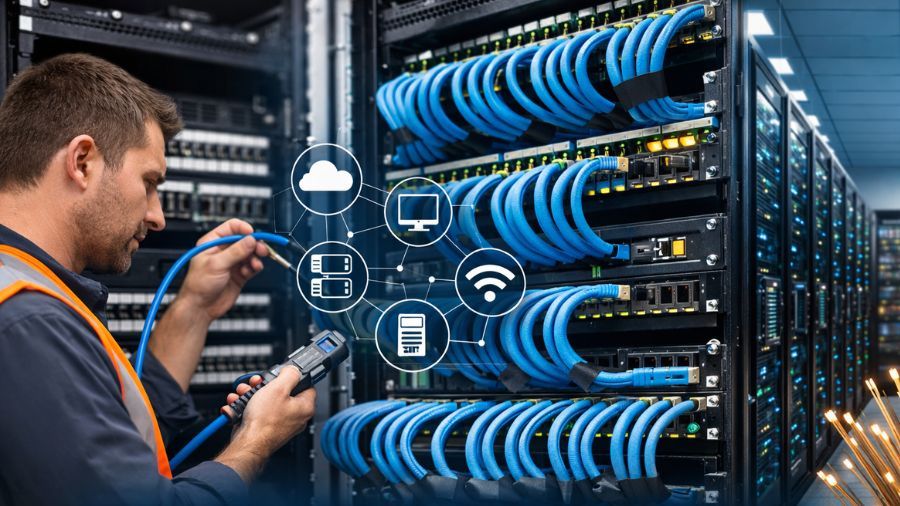
To comprehend its value, imagine two distinct office formations. In the first, every time a new employee joins, a specialist operates a single, long wire from the server room directly to their desk. Over time, this makes a rat nest of messy wires that are impossible to track. This is known as point-to-point cabling, and it is a recipe for digital disasters.
In contrast, structured cabling system utilizes a standardized system. It organizes cables into manageable blocks and subsystems, all meeting at a central Patch Panel. Every platform in the wall is labeled and mapped.
The subsystems of structured cabling –
1. Entrance Facilities – Where the ISP lines enter the building.
2. Backbone Cabling – The high-speed highway that links various floors or tool rooms.
3. Horizontal Cabling – The wires operating from the floor’s wiring closet to individual desks or gadgets.
4. Work Area Components – The final patch cords that link your laptop or IP Phone to the wall platform.
Why Your Dubai Office Needs Modern Structured Cabling in 2026
Below is a thorough breakdown of why modern structured cabling is the most crucial investment for Dubai offices this year –
1. Fueling the AI and Big Data Revolution
In 2026, Artificial Intelligence is not only a buzzword, but it is also integrated into everyday office software, from real-time predictive analytics to productive design tools. These applications process huge datasets that should travel between local workstations and edge data centers immediately.
- Removing Bottlenecks – Older systems usually struggle to exceed 1Gbps over long distances. Advanced structured cabling solutions in Dubai prioritize Cat6A or Fiber Optic cabling, which is trusted to support speeds of 10Gbps and higher.
- Latency Reduction – High-speed cabling decreases ping or delay. In a high-stakes market like Dubai, some milliseconds of lag during an AI-driven financial trade or a live data sync can lead to remarkable functional losses.
2. The Backbone of IoT and Green Smart Buildings
Dubai’s dedication to stability and the Net Zero vision has led to the rise of intelligent buildings. Contemporary offices now utilize the network to handle much more than only computers.
- Power Over Ethernet Integration – One of the amazing benefits of contemporary cabling is the capability to provide both data and electricity over a single copper cable. Modern structured cabling solutions UAE providers install today use PoE++, which can provide up to 90W of power.
- Centralized Control – This permits you to power LED lighting, smart thermostat, biometric security scanners, and window shade controllers directly through your network. It removes the requirement for separate electrical wiring for every small gadget, decreasing installation expenses and permitting for centralized energy management through a single software dashboard.
3. Agility for Hybrid and Flexible Work Models
The rigid office layouts of the past are gone. The 2026 Dubai workplace is described by fluidity, hot-desking, cooperative zones, and plug-and-play meeting pods, which are the standard.
- Handling MAC – In an unstructured noodle wiring formation, moving a department to a distinct floor or adding ten new desks is a logistical nightmare that can take days.
- The Zone Cabling Advantage – An expert network cabling company in Dubai will execute a Zone Distribution model. Rather than operating every wire back to the primary server room, cables are operated to localized consolidation points in the ceiling or under the floor. This makes reconfiguring an office plan as easy as swapping some short patch cords instead of ripping out miles of permanent wiring.
Key Technologies in 2026 – Cat6A vs. Fiber Optics

When seeking a network cabling company in Dubai, you have to decide which media or cable type suits your requirements. In 2026, the industry has moved away from older norms like Cat5.
1. Category 6 Augmented (Cat6A) – This is the latest gold standard for copper cabling in Dubai offices. It supports 10Gbps speeds at a distance of up to 100 meters. It facilitates enhanced protection to decrease crosstalk, which is crucial in dense office towers.
2. Fiber Optic Cabling – For the spine of your building or for high-demand industries, such as finance and media, Fiber Optic is crucial. It utilizes light rather than electricity, meaning it can hold more data over much longer distances without any signal loss. In 2026, a number of structured cabling company in Dubai projects are executing fiber to the desk for zero-latency performance.
Integrating with IT Support in Dubai

The hardware that your cables connect to is what makes them work. This is why a lot of businesses in Dubai look for a provider that can also help with all of their IT needs. You can be sure that your routers, switches, and firewalls are set up just right for your physical infrastructure if the same team takes care of your cabling and your IT support company in Dubai.
This “all-in-one” method makes upkeep easier. You can check both the physical wires and the software settings with just one call if your internet goes down.
Conclusion
The speed of business will only get faster as we look ahead to the rest of 2026 and beyond. Your office’s infrastructure should help you grow, not get in the way of your progress. By buying high-quality Structured Cabling Solutions in Dubai, you are making sure that your business is ready for the next wave of new technology.
Working with an expert like Liberty UAE gives you peace of mind that your network is safe, fast, and reliable, whether you need a simple office setup or a complicated data center installation.
Also Read: Best IT AMC Solutions in Dubai for Large Enterprises
1. What is structured cabling and why is it important in 2026?
Structured cabling is a standardized architecture for an office’s data and voice communication. In 2026, it is essential because it delivers the enormous bandwidth required for AI-driven applications and the high-speed connectivity required for 10Gbps contemporary networks.
2. Why do modern offices in Dubai need structured cabling?
Dubai’s “Smart City” initiatives demand buildings to be positively integrated. Structured cabling supports the IoT gadgets, smart lighting, and high-density wireless systems that are now standard in Dubai’s exceptional commercial spaces.
3. What are the main components of a structured cabling system?
The system consists of six key parts: Entrance Facilities, Equipment Rooms, Backbone Cabling, Telecommunications Rooms, Horizontal Cabling, and Work Area Components.
4. How does structured cabling benefit large offices?
It stops the chaos of “spaghetti wiring.” For big teams, it confirms that moving an employee’s desk or adding new hardware doesn’t need a total network overhaul, greatly decreasing long-term maintenance expenses.
5. Is structured cabling suitable for multi-floor or multi-building offices?
Yes. It is particularly created for this. By utilizing high-speed Fiber Optic “Backbone” cabling to link various floors or buildings, it confirms uniform high-speed internet access across the whole campus.
6. What industries benefit most from structured cabling in Dubai?
While all advantages, the finance, healthcare, hospitality, and IT industries in Dubai see the most growth. These industries depend on zero-latency data transfers and 24/7 network trustworthiness for their day-to-day operations.
7. What types of cables are used in structured cabling?
The most typical are Cat6A (copper) for workstation connections and Fiber Optic cables (Single-mode or Multi-mode) for high-speed backbones and data centers.
8. What is the difference between fiber optic and copper cabling?
Copper (Cat6A) is affordable and provides power via PoE, but has distance limits. Fiber optic uses light signals, delivering much higher speeds over kilometers, and is immune to the electromagnetic interference standard in high-rise buildings.
9. What services are included in structured cabling solutions?
Extensive solutions include site surveys, network design, cable installation, labeling, rack mounting, and strict testing with certification reports to confirm the system fulfills international standards.
10. How long does structured cabling installation take?
It differs by office size. A small office might take 2–3 days, while a multi-floor headquarters could take many weeks. Masterful providers like Liberty UAE simplify this to decrease business disruption.
11. Can structured cabling be customized for office layouts?
Definitely. It is planned to be “modular.” Whether you have an open-plan collective space or a standard partitioned office, the cabling can be routed under floors or through ceilings to match your precise layout.
12. Is structured cabling a good investment?
Yes. It is believed to be a “future-proof” investment. It improves the property value of the office and decreases the demand for costly rewiring every time technology evolves, delivering a high ROI over 10–15 years.
13. How does structured cabling improve network performance?
Decreasing signal crosstalk and using high-quality parts decreases data packet loss. This results in faster download speeds, clearer VoIP calls, and more stable video conferencing.
14. Can structured cabling integrate with security systems?
Yes. Contemporary systems are developed to support IP-based protection, including 4K CCTV cameras, biometric access control, and motion sensors, all running on the same organized infrastructure.